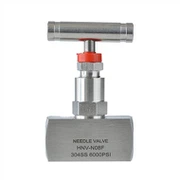
Needle Valve Performance Monitoring And Evaluation Method
Jun 30, 2025
In industrial fluid control systems, needle valves are a vital component, and their performance will directly affect the stable operation and work efficiency of the entire system. Needle valves are a typical electromechanical and hydraulic integrated product, involving many disciplines such as machinery, hydraulics, electronics, computers and sensor technology. In various industrial application scenarios, needle valves are widely used in many industries such as petroleum, chemical, electric power and pharmaceuticals. They are responsible for adjusting flow, managing pressure and preventing leakage. Due to the harsh working environment and changing working conditions, needle valves often operate in complex environments, which makes it easy for the needle valve to malfunction or even fail. Therefore, continuous monitoring and accurate evaluation of needle valve performance are crucial to ensure the safety of the system and improve production efficiency.
The purpose of this article is to deeply study the core issues and methods in the monitoring and evaluation of needle valve performance, hoping to provide solid support for the further optimization of industrial fluid control systems
Main parameters for needle valve performance monitoring
Flow monitoring
In the process of monitoring needle valve performance, flow monitoring occupies a central position. At present, needle valve flow detection mainly adopts manual measurement or automatic calculation by instruments, which is inefficient and has poor accuracy. By real-time monitoring of needle valve flow, we can clearly understand its adjustment function and current working status. In practical applications, due to different measurement objects, the methods used are also different. There are many ways to monitor flow, including the use of tools such as flow meters and pressure sensors. The performance of needle valves is significantly affected by flow changes. Abnormal flow changes may be a harbinger of problems such as needle valve wear, blockage or leakage.
Pressure Monitoring
When evaluating needle valve performance, pressure monitoring is considered one of the key methods. When the upstream pressure of the needle valve is too high or too low, it will cause the needle valve to leak, and in severe cases, the entire system will be paralyzed. By monitoring the pressure changes upstream and downstream of the needle valve, we can evaluate its pressure adjustment ability and sealing effect. The fluid flow state inside the needle valve is closely related to the external environment. Based on the operating mechanism of the pressure sensor, the basic principle of pressure monitoring is to convert the pressure signal into an electronic signal for further transmission and processing. The performance of the needle valve is significantly affected by pressure fluctuations. If the pressure fluctuations are too large, it may cause damage or failure of the needle valve.
Leakage rate monitoring
In order to ensure the sealing effect of the needle valve, leakage rate monitoring is particularly critical. The leakage rate is affected by many factors, such as materials and structure, working medium and environmental conditions. By real-time monitoring of the leakage status of the needle valve, we can quickly identify and solve possible leakage problems, thereby reducing further damage. Excessive leakage rate may cause valve damage or even fire accidents, so the sealing and safety of the needle valve must be considered when maintaining and servicing the needle valve. In order to monitor the leakage rate, we use a variety of methods, including the use of leak detection equipment and observing the specific situation of the leakage. The leakage rate is closely related to the working performance of the needle valve. If the leakage rate is too high, the sealing of the needle valve will be affected, so corresponding maintenance or replacement is required.
Other parameters
In addition to the key parameters mentioned above, factors such as temperature and vibration may also have a certain impact on the performance of the needle valve. In addition, due to the complex structure and working conditions of the needle valve, there are multiple fluid flow modes and heat transfer processes inside it, which brings certain difficulties to the monitoring of needle valve performance. Therefore, in the process of monitoring the performance of the needle valve, we also need to pay close attention to the dynamic changes of these parameters.
Existing needle valve performance evaluation methods
Theoretical analysis method
By constructing mathematical and simulation models, we can make in-depth predictions and evaluations of the working performance of the needle valve. Based on the analysis of various existing modeling methods, a parametric modeling method for needle valves based on genetic algorithms is proposed. Although this method performs well in terms of cost and cycle, it may not fully demonstrate the true performance of the needle valve due to the accuracy and complexity of the model.
Experimental test method
In order to obtain the performance data of the needle valve, we built an experimental platform and conducted field tests on it. On this basis, the least squares support vector machine method was used to establish a mathematical model, and the model was applied to the design of a certain type of hydraulic coupling, achieving good results. This method has obvious advantages in intuitiveness and accuracy, but it also requires higher costs and longer execution cycles. Therefore, it is necessary to develop a low-cost test method to replace the traditional experimental method so that it can be applied to production more quickly. The experimental test methods cover multiple aspects of detection such as flow, pressure and leakage.
Numerical simulation method
Numerical simulation technology uses computer simulation methods to deeply simulate and analyze the working performance of needle valves. Traditional needle valve performance analysis methods mainly include experimental method and theoretical analysis method. This method is characterized by its low cost, high efficiency and good repeatability, but its performance is still limited by computer performance and simulation model accuracy. In order to overcome these shortcomings, a needle valve test platform based on virtual instruments was established using the research idea of combining experimental testing with theory. Numerical simulation technology can simulate the performance of needle valves under various working conditions, providing a solid basis for performance evaluation.
How to realize real-time monitoring of needle valve performance
Sensor technology
Sensor technology plays a core role in real-time monitoring of needle valve performance. Several typical sensor types and their working principles currently used in needle valve detection are introduced. By carefully selecting the type of sensor and the appropriate installation location, we can monitor the key parameters of the needle valve such as flow, pressure and temperature in real time. At present, the needle valve detection device mainly uses photoelectric encoders or Hall elements as displacement measurement elements. Although sensor technology has the characteristics of fast response and high precision, its stability and reliability issues cannot be ignored.
Data acquisition and processing
In order to monitor the performance of the needle valve in real time, data collection and processing are particularly critical. In the process of testing the characteristics of the needle valve, various types of measuring instruments need to be integrated into a system to complete complex and tedious work. By collecting, processing and analyzing the output signals of the sensor, we can obtain relevant data on the performance of the needle valve. At present, virtual instrument technology is the most used in practical applications, but this method requires professionals to develop related programs and is expensive. Choosing appropriate data acquisition and processing software or platform is very critical to ensure the accuracy and stability of the data.
Construction of real-time monitoring system
Establishing a real-time monitoring system is the core link for real-time monitoring of the performance of the needle valve. The working environment of the needle valve is relatively harsh and has high temperature characteristics. Therefore, the non-contact measurement method can accurately obtain the internal pressure change information of the needle valve. By building a real-time monitoring platform, we can continuously observe and warn the performance of the needle valve. The real-time monitoring system has functions such as data acquisition and analysis processing, data analysis and alarm prompts. In order to ensure that the real-time monitoring system can meet the needs of actual applications, its architecture and functional requirements should be customized according to specific application scenarios.
How to determine the evaluation criteria and thresholds in the needle valve performance evaluation
Formulation of evaluation criteria
In order to ensure the accuracy of needle valve performance evaluation, it is crucial to formulate evaluation criteria. Based on the analysis of the advantages and disadvantages of various existing evaluation criteria, a rapid evaluation method for needle valve performance parameters based on expert knowledge reasoning is proposed, and the main issues involved in this method are studied and discussed. In order to ensure the scientificity and rationality of the evaluation criteria, we should formulate them based on the actual application environment and industry standards. There are large differences in the test methods and parameters used in needle valve performance testing on different types of products, so the evaluation criteria are also different. In different industries or application environments, different evaluation criteria may lead to different evaluation results, so corresponding adjustments and optimizations need to be made according to actual conditions.
Determination of thresholds
In order to ensure the accuracy of needle valve performance evaluation, the setting of thresholds is particularly critical. Through the analysis of existing threshold calculation methods, it is found that there are certain differences in the test results obtained by different test methods. In order to ensure that the threshold can truly reflect the working condition of the needle valve, we should set it according to the evaluation criteria and actual needs. This paper theoretically analyzes the relationship between valve port leakage and flow rate, and combines test data to give a new valve port pressure threshold calculation model based on the flow range. The technical means to determine the threshold include statistical analysis and expert practical experience. This paper mainly studies how to select the best threshold when establishing a valve seat wear model based on statistical methods. When evaluating needle valve performance, the importance of the threshold is obvious. Too high a threshold may lead to missed detection, while too low a threshold may lead to false alarms.
What are the similarities and differences in performance monitoring and evaluation methods for different types of needle valves
Characteristics of different types of needle valves
Different types of needle valves differ in their materials, sizes and functions, and these differences may affect their performance detection and evaluation methods. In order to accurately reflect the differences in the degree of influence of different types of needle valves on valve quality control indicators during operation, it is necessary to establish a corresponding performance detection and evaluation system for different types of needle valves. For example, when designing a needle valve for high temperature and high pressure, its tolerance to high temperature and high pressure must be considered, while for a needle valve for precision adjustment, attention must be paid to the accuracy and stability of its adjustment
Differences and similarities in performance monitoring methods
Different types of needle valves may have similarities and differences in performance testing methods. Through comparative analysis of needle valve testing instruments at home and abroad, the commonalities and differences in the field of needle valve testing technology are summarized. From the perspective of commonality, each needle valve must monitor key parameters such as flow, pressure and leakage rate. In terms of differences, different types of needle valves may require different types of sensors and detection methods. Therefore, it is necessary to conduct a comparative study on the characteristics and monitoring technologies of different types of needle valves to provide a reference for selecting appropriate needle valves. For example, a needle valve for high temperature and high pressure may require the use of a sensor that can withstand high temperature and high pressure
Differences and similarities in performance evaluation methods
Different types of needle valves may also have similarities and differences in performance evaluation methods. The main evaluation methods and their characteristics are introduced for different types of needle valves, and the relationship between the methods is briefly explained. From the perspective of commonality, each needle valve should be evaluated according to the established evaluation criteria and thresholds. In terms of differences, different types of needle valves may require different evaluation methods and metrics. Therefore, it is very important to choose a suitable evaluation method for a specific type of needle valve. For example, in order to ensure the adjustment accuracy and stability of the precision adjustment needle valve, a higher level of evaluation criteria and a more stringent evaluation method may be required.
In general, the performance monitoring and evaluation method of the needle valve includes multiple key steps and multiple parameters. By carefully selecting appropriate monitoring parameters and evaluation methods, we can continuously monitor and accurately evaluate the performance of the needle valve. In actual engineering, the use of different types of monitoring instruments or evaluation models to continuously monitor the working status of the needle valve under different working conditions in real time and give reasonable conclusions is an important guarantee to ensure the stable operation of industrial production. However, with the continuous advancement of industrial technology and the continuous evolution of application scenarios, the monitoring and evaluation methods of needle valve performance also need to be continuously updated and optimized. Therefore, under the current research background, how to use advanced science and technology to improve the efficiency, accuracy and stability of needle valve performance monitoring is a key issue that needs to be solved in the future. In the future, we are expected to see the emergence of more intelligent and automated monitoring and evaluation technologies, providing a solid backing for the further optimization of industrial fluid control systems. To this end, this article introduces the current research status and existing problems of needle valve performance monitors at home and abroad, and looks forward to its development prospects. At the same time, we also need to pay close attention to the application and development direction of new technologies and new methods to promote the continuous progress and innovation of needle valve performance monitoring and evaluation technology.