Call Us: +86-577-66990028Email: sales@huancheng-valve.com
enLanguage

Pressure Gauge Accessories

Why Choose Us?


Professional Team
Wenzhou Huancheng Pipeline Valve Co., Ltd (Huancheng) founded in1996,China.We are a leading and professional manufacturer for all kind of valve and fittings.


Complete Range of Products
Our mainly products cover below :Stainless steel pipe thread fittings,stainless steel compression fitting/Stainless steel pneumatic fittings / sanitary pipe fitting / pipe flange .stainless steel high pressure fitting .brass pipe fittings,butterfly valve, safety valve ,ball valve, gate valve, globe valve, check valve,safety valve. needle valve , pressure gauge accessories, Sanitary diaphragm pump.


Widely Used Products
Our products are suitable for various industries like Petrochemical, Oil and Gas, Petroleum refinery,Metallurgy, Energy, Water and Sewage lines, Food, Pharmacy, electric appliance,car, Power station and Ship building.

What Is a Pressure Syphon Tube


A pressure syphon tube is a simple device used to protect a pressure sensor from high-temperature media, such as steam. It can also be used to reduce the potentially damaging effects of rapid pressure changes. These low-cost devices allow systems builders to use a pressure sensor with a much lower temperature range in high-temperature applications.

What Is the Principle of Pressure Syphon Tube


A pressure syphon tube is a tubular device that is bent to form two legs of unequal length. It is used to transfer liquid from a higher to a lower elevation. The pressure syphon tube action depends upon the influence of gravity (not, as sometimes thought, on the difference in atmospheric pressure—A pressure syphon tube will work in a vacuum) and upon the cohesive forces that prevent the columns of liquid from separating under their own weight. The smaller amount of water in the pressure syphon tube's short leg is drawn through the device by the weight of the larger amount of water in the long leg.


Pressure syphon tube flow starts when part of the water in the long arm flows out in an attempt to equalize the weights of water in the two arms. A temporary vacuum is formed, but it is at once filled with water that is sucked up into the short arm because of the difference of the pressure on the liquid at the two ends of the tube. The liquid will continue to flow until one of the following occurs: The upper container is empty, the water levels are equal, or air enters the short end of the tube.

Types of Pressure Syphon Tube
 

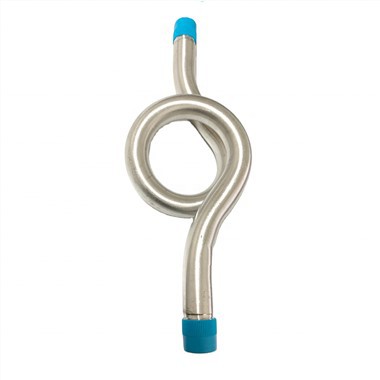
The pressure gauge syphon are mainly available in three types sequentially, coil syphon, pigtail syphon and U type syphon and each is designed to match different application requirements of the industries using a pressure gauge.

Coil syphon – used primarily for horizontal installations

The coil shaped syphon design is a reason for its recognition as a coil syphon tube, which are extensively celebrated in the industries for its effectiveness in preventing pressure gauge from the effect of hot pressure media and reducing the effect of quick pressure surges. This coil syphon permits the formation of condensate that gathered inside the syphon and hence prevents direct contact of hot media with the pressure instruments. The excellent command of this coil syphon has made it widely popular as freeze protector.


Coil syphons are used significantly to protect pressure instruments, pressure gauge syphon, switches and transmitters straightly contacting with high temperature process fluids or vapours. This coil syphon is installed between process and pressure instruments and filled with condensation fluids that reduce process pulsation and function as heat dispensed and save instrument from working at unsafe temperatures.

Pig tail syphon – used primarily for vertical installations

The pigtail syphon is a looped pipe filled with water, designed profoundly to guard the internal parts of the steam pressure gauges from coming elevated steam temperature, as is one of the highly sensitive measuring instruments that demands significant caution in order to prevent the damage or destroy. This pigtail pressure gauge syphon permits changing of gas into a liquid by dissolving the hidden heat energy of steam and permit steam to condense, thus develop a loop seal of liquid that put off the conveyance of heat energy from the steam to the respective gauge. This pigtail syphon has well liked in the market for its impeccable operation and reliability measures that also widely accepted to protect the steam pressure gauge from any pressure surges in the system. During the application, it is recommended to fill the pigtail syphon with water or other parallel liquid substance former installation.


The pigtail syphon is installed between process and process instruments in order to protect the measuring instruments, including pressure instruments, gauges, switches and transmitter from the entering high temperature process vapours. Other than, this pigtail syphon known to be effective in preventing the instrument to work at hazardous temperature. This pigtail syphon is being prominent in the industries for its influential functioning all through its life and ensuring safety of the respective instrument.

U type syphon – used primarily for horizontal installations

The u shape of the pipe connected between the pressure gauge and process makes it renowned as the u type syphon in the industries. This u type syphon is globally accepted for its outstanding performance, used widely to prevent the entering of hot media into the measuring instrument hence protect the instrument from the damage. This u types syphon permits condensate to form and be accumulated inside the syphon that prevents direct contacting of the hot vapors with the pressure instrument. However, it is counseled filling the u type syphon together with a cooling separating liquid ahead of starting the pressure line. This u type syphon is also being prominent in the heating dispersion that prevents instrument to work at hazardous temperature.


The U type syphon is equipped between process and process instruments to ensure safety of the pressure instruments, gauges, switches and transmitter from the entering high temperature vapor. This U type syphon intensifying popularity in the diverse industries is an evidence of its worthiness, which is also being used to avoid instrument to work at dangerous temperature.

Functions of Pressure Syphon Tubes


Protecting pressure instruments

Pressure syphon tubes prevent hot steam from directly contacting pressure sensing elements, which could otherwise be damaged by high temperatures.


Sealing against noxious gases

They create seals to stop sewer gases from entering buildings, thus maintaining a safe and odor-free environment.


Controlling fluid flow

They manage the flow of liquids to minimize the effects of rapid pressure changes, ensuring a stable operation.


Applications of Pressure Syphon Tube
 
01/

Steam boilers

These are used for precise water level measurement in steam boilers and are connected to pressure gauges.

02/

Industrial processes

Protect pressure instruments from high temperatures in chemical processing plants.

03/

Automotive

Prevent coolant from damaging temperature sensors in automotive cooling systems.

04/

Hydraulic systems

Measure fluid levels accurately without exposing instruments to full hydraulic fluid force.

05/

HVAC systems

Measure the pressure of refrigerants accurately while shielding instruments from extreme temperatures.

06/

Water tanks

Measure water levels accurately in high-temperature environments without exposing instruments to excessive heat.

07/

Laboratory equipment

Transfer liquids between containers at a constant flow rate in laboratory equipment.

08/

Oil and gas industry

Measure fluid levels and pressures in pipelines and storage tanks for safe operations in the oil and gas industry.

What Is Pressure Snubber


Pressure gauge snubbers are intended to suppress the effect of pressure pulses and pressure peaks, which are common reasons for gauge failure. Porous snubbers incorporate a fixed mesh disk. Piston snubbers are supplied with five pistons for use with a variety of media.

Types of Pressure Snubber
 

The fixed disc creates a semi-permeable barrier between the incoming pressure and the pressure gauge's orifice. The pressure meets that disc and has its force distributed through the metal mesh, slowing it so that it will not harm the gauge. The pressure rises gradually, so that the gauge doesn't jump a gear or burst a tube.


The porous disc design allows consistent pressure at low speeds, though, so that the gauge's readings are not affected by the filtering material.


The downside of a porous disc snubber is that it can become clogged, depending on the process being measured. In that case, the readings would be affected and the snubber would have to be cleaned by flushing it from the gauge side with a solvent.


A piston-type snubber has a little more advanced design that is often self-cleaning. Often designed in two pieces, the piston inside the snubber moves freely, acting as a barrier to the rapid increase in pressure. When pressure increases too rapidly, the piston is forced against the orifice leading to the gauge, stemming the flow for milliseconds. As long as it is just a spike, that should be long enough to avoid damage to the gauge.

不锈钢可调压力缓冲器


黄铜压力缓冲器

This type of snubber can usually be "tuned" to meet a process's needs by using easily changed pistons of varying sizes. The diameter of the piston and its clearance within the snubber determine the rate of "dampening" that occurs.


A third "adjustable" snubber takes that fine tuning to another level. Many use a combination of a ball check to block surges and a kind of choke valve to smooth out the flow of material into the gauge. The ball check acts a lot like the piston-type snubber in that it is a passive element until a rapid change in pressure pushes it into action.


Even adjustable snubbers without the ball check can be effective in smoothing out a lot of pulsation, thanks to the integrated choke valve, which will only allow so much fluid through at one time.In that case, it was a major momentary spike in pressure that damaged the gauge and a needle valve alone wouldn't have completely arrested the surge.

Tips for Selecting and Operating the Right Pressure Snubber


A pressure snubber equalizes the rate at which a fluid or gas arrives at the measuring point. The use of a snubber in pressure gauge applications does not alter the process pressure, it will reduce pulsations on the line, thus improving the accuracy of gauge readings, and extending the life of that specific gauge.


Price

A snubbers price varies depending on several factors. In the low end of the spectrum is the porous disc snubber, but can come clogged and cant be fine-tuned. Snubbers with piston mechanisms tend to be more expensive, but dont get clogged and can be tuned.


Housing material

The housing material is often brass or stainless steel, although materials like monel and steel are also used. The below table shows brass and stainless steel as a guideline to snubber pressure ratings.


Snubber chemical compatibility

For the most part snubbers are made out of copper alloys like brass or stainless steel. Although stainless steel has superior chemical resistance, these snubbers do tend to be more costly. If your application does not need to have these properties a brass snubber would be the preferred option.
● Brass snubbers: Brass snubbers are suitable for neutral and non- corrosive media. They are resistant to water, (compressed) air, oils and many other media. However, brass should not be used with salt or seawater, distilled water, acids, and chlorides.
● Stainless steel snubbers: These have the advantage of being chemically resistant to almost any medium except hydrochloric acids, chlorides, bromine and household bleach. It has high wear, temperature, and pressure resistance.


Dynamic load cycles

Various processes subject pressure gauges to temporary heavy loads, also called vibrations or pulsations. The measurement instrument can be permanently damaged by these dynamic load cycles, for example from a reciprocating pump. Before purchasing a snubber determine the load cycles in your system. Installing the correct snubber for the load cycles in a system will prevent excess costs and damage to vital components.


Temperature

High temperatures can affect pressure gauges as well as load cycling, depending on the process. Adding a syphon can be advantageous in such cases. The protection is particularly effective when hot media, like vapour, are present in conjunction with load cycles.


Pressure suitability

When choosing a pressure snubber, ensure that it is appropriate for the process in which it will be used. Installing a snubber rated at a lower pressure in a highly pressurized system will be problematic. Snubbers should be selected based on the pressure range determined by the pressure generated by the system. Snubber pressure ratings vary from low pressures to 36000 psi (2500 bar). The pressure rating of a snubber depends on the type, orifice size, material, and thread size.

 
Our Factory

Wenzhou Huancheng Pipeline Valve Co., Ltd (Huancheng) founded in1996,China .We are a leading and professional manufacturer for all kind of valve and fittings.
Huancheng is devoted to being a world-class supplier for submit to international markets all types of valves in an extensive wide range of material, sizes and pressure classes for various industry sectors like Petrochemical, Oil and Gas, Petroleum refinery,Metallurgy, Energy, Water and Sewage lines, Food, Pharmacy, electric appliance,car, Power station and Ship building.

productcate-1-1
productcate-800-595
productcate-800-595
productcate-800-595
FAQ

Q: What are the pressure gauge accessories?

A: These accessories include components like gauge snubbers, isolators, adaptors, and mounting hardware, crucial for maintaining gauge accuracy and protecting instruments in challenging environments.

Q: What is a pressure syphon tube?

A: A pressure syphon tube is a simple device used to protect a pressure sensor from high-temperature media, such as steam. It can also be used to reduce the potentially damaging effects of rapid pressure changes. These low-cost devices allow systems builders to use a pressure sensor with a much lower temperature range in high-temperature applications.

Q: What is the purpose of a pressure syphon tube?

A: Pressure syphon tube is a device used to protect pressure gauges against the effect of high-temperature environments as well as reducing the effect of pressure surges that could potentially damage the function of a pressure gauge.

Q: Do we understand how pressure syphon tubes work?

A: When a certain amount of water moves over the bend in the siphon, gravity pulls it down on the longer leg lowers the atmospheric pressure in the bend of the siphon. The atmospheric pressure on the other side of the siphon becomes stronger and forces the rest of the water up and over the bend in the siphon.

Q: What is pressure snubber?

A: Pressure gauge snubbers are intended to suppress the effect of pressure pulses and pressure peaks, which are common reasons for gauge failure. Porous snubbers incorporate a fixed mesh disk. Piston snubbers are supplied with five pistons for use with a variety of media.

Q: How does a pressure syphon tube work pressure?

A: While if both ends of a pressure syphon tube are at atmospheric pressure, liquid flows from high to low, if the bottom end of a siphon is pressurized, liquid can flow from low to high. If pressure is removed from the bottom end, the liquid flow will reverse, illustrating that it is pressure driving the siphon.

Q: What is the principle of pressure syphon tube?

A: Siphon flow starts when part of the water in the long arm flows out in an attempt to equalize the weights of water in the two arms. A temporary vacuum is formed, but it is at once filled with water that is sucked up into the short arm because of the difference of the pressure on the liquid at the two ends of the tube.

Q: What are the types of pressure snubbers?

A: The fixed disc creates a semi-permeable barrier between the incoming pressure and the pressure gauge's orifice. The pressure meets that disc and has its force distributed through the metal mesh, slowing it so that it will not harm the gauge. The pressure rises gradually, so that the gauge doesn't jump a gear or burst a tube.
The porous disc design allows consistent pressure at low speeds, though, so that the gauge's readings are not affected by the filtering material.
The downside of a porous disc snubber is that it can become clogged, depending on the process being measured. In that case, the readings would be affected and the snubber would have to be cleaned by flushing it from the gauge side with a solvent.
A piston-type snubber has a little more advanced design that is often self-cleaning. Often designed in two pieces, the piston inside the snubber moves freely, acting as a barrier to the rapid increase in pressure. When pressure increases too rapidly, the piston is forced against the orifice leading to the gauge, stemming the flow for milliseconds. As long as it is just a spike, that should be long enough to avoid damage to the gauge.

Q: When to use a pressure syphon tube?

A: A pressure syphon tube is a simple device used to protect a pressure sensor from high-temperature media, such as steam. It can also be used to reduce the potentially damaging effects of rapid pressure changes.

Q: What are the types of pressure syphon tube?

A: The pressure syphon tube are mainly available in three types sequentially, coil syphon, pigtail syphon and U Type syphon and each is designed to match different application requirements of the industries using a pressure gauge.

Q: What are the applications of pressure syphon tubes?

A: ● Steam boilers: These are used for precise water level measurement in steam boilers and are connected to pressure gauges.
● Industrial processes: Protect pressure instruments from high temperatures in chemical processing plants.
● Automotive: Prevent coolant from damaging temperature sensors in automotive cooling systems.
● Hydraulic systems: Measure fluid levels accurately without exposing instruments to full hydraulic fluid force.
● HVAC systems: Measure the pressure of refrigerants accurately while shielding instruments from extreme temperatures.

Q: What is the difference between siphon and syphon?

A: Syphon is an alternative spelling of siphon. You'll see syphon used more often in British English than American, but both spellings are acceptable. You can syphon out the excess fluid using the pump provided.

Q: What are the characteristics of a pressure syphon tube?

A: Pressure syphon tube, in its simplest form, is a tube in an inverted U shape that transfers fluid by pressure variation from one reservoir to another at a different height. In this equation, refers to the pressure, symbolizes the liquid density, is the acceleration due to gravity, and is the height difference.

Q: What is the importance of pressure syphon tube?

A: Pressure syphon tubes are a basic implement used in irrigation to transfer water over a barrier (such as the bank of a raised irrigation canal), using the siphon principle. At the simplest they consist of a pipe with no working parts.

Q: What is the function of the pressure syphon tube?

A: Pressure syphon tube is a tube that allows liquid to travel upward, above the surface of the origin reservoir, then downwards to a lower level without using a pump. When a certain amount of water moves over the bend in the siphon, gravity pulls it down on the longer leg lowers the atmospheric pressure in the bend of the siphon.

Q: What is a pressure snubber used for?

A: Pressure snubberr is a device used to suppress ("snub") excess force or rapid movement in mechanical systems. Pressure snubbers are designed to dampen the effect of pressure pulses and spikes to assure longer service life and readability of pressure gauges in harsh applications.

Q: How does a pressure snubber work?

A: Pressure snubbers have a free moving piston inside of the snubbers body. If the pressure increases rapidly, it moves the piston against the gauges orifice.

Q: Does a pressure snubber extend the lifespan of a pressure gauge

A: Reduces stress on gauge components, prolonging their lifespan and saving costs on replacements.

Q: What is the function of pressure snubber damping mechanism

A: The core principle behind a pressure snubber's operation revolves around restricting and controlling the flow of fluid or gas reaching the pressure gauge. This restriction creates a damping effect, smoothing out rapid pressure fluctuations.

Q: How to choose a gauge snubber?

A: The pressure snubber works by evening out the rate at which the fluid or gas being measured arrives. While the snubber does not alter the pressure of the process, it will lessen the pulsation on the line, thereby improving the consistency of the gauge reading, and extending the effective lifetime of that particular gauge.

We're professional pressure gauge accessories manufacturers and suppliers in China, specialized in providing high quality products with low price. We warmly welcome you to wholesale pressure gauge accessories in stock here from our factory. For customized service, contact us now.

valve supplier, hydraulic valve, couplings

(0/10)

clearall