

What is the role of the stem in a stainless steel threaded ball valve?
Oct 06, 2025
The stem in a stainless steel threaded ball valve plays a crucial and multi - faceted role that is integral to the valve's overall functionality, reliability, and performance. As a leading supplier of stainless steel threaded ball valves, I have witnessed firsthand the significance of the stem in various industrial applications.
1. Mechanical Linkage and Actuation
The primary role of the stem in a stainless steel threaded ball valve is to provide a mechanical linkage between the actuator and the ball. The actuator, which can be a manual handle, an electric motor, a pneumatic cylinder, or a hydraulic device, applies a rotational force to the stem. This rotational motion is then transmitted directly to the ball inside the valve body.
For instance, in a manual operation, an operator turns the handle attached to the stem. As the stem rotates, it causes the ball to rotate within the valve. The ball has a bore through its center, and by rotating the ball, the bore can be aligned with the flow path of the pipeline (open position) or perpendicular to it (closed position). This simple yet effective mechanism allows for precise control of the fluid flow.
In automated systems, the actuator is controlled by a control signal. The stem still serves as the vital link that transfers the motion from the actuator to the ball. Whether it is a Three Piece Ball Valve or a One Piece Ball Valve, the stem's ability to accurately transmit rotational motion is essential for proper valve operation.
2. Sealing and Leakage Prevention
Another critical role of the stem is to maintain a proper seal within the valve. The stem passes through the valve body, and there is a potential for fluid leakage along the stem. To prevent this, special sealing arrangements are used around the stem.
Typically, packing materials such as PTFE (Polytetrafluoroethylene) or graphite are used to create a tight seal between the stem and the valve body. These packing materials are compressed around the stem, forming a barrier that prevents the fluid from escaping. The stem must be designed to work in harmony with the packing. It should have a smooth surface finish to minimize friction and wear on the packing while still providing a tight seal.
In high - pressure applications, the stem's design becomes even more crucial. The stem must be able to withstand the forces exerted by the high - pressure fluid without deforming or causing the packing to fail. A well - designed stem in a Three Piece Extension Tube Butt Welded Ball Valve can ensure reliable sealing even under extreme pressure conditions.
3. Torque Transmission and Control
The stem is responsible for transmitting the torque required to open and close the valve. The amount of torque needed depends on several factors, including the size of the valve, the pressure of the fluid, and the type of seat material used in the valve.
In larger valves, more torque is required to rotate the ball. The stem must be strong enough to transmit this torque without breaking or deforming. It is also important to control the torque applied to the stem. Excessive torque can damage the valve components, such as the ball, seat, or packing. On the other hand, insufficient torque may result in an incomplete opening or closing of the valve, leading to leakage or improper flow control.
Valve manufacturers often specify the maximum and minimum torque values for their valves. The stem design is optimized to ensure that it can transmit the appropriate amount of torque within these specified limits. This is especially important in applications where precise flow control is required, such as in chemical processing plants or water treatment facilities.
4. Material Compatibility and Corrosion Resistance
Since the stem is in contact with the fluid flowing through the valve, it must be made of a material that is compatible with the fluid. In stainless steel threaded ball valves, the stem is typically made of stainless steel, which offers excellent corrosion resistance.
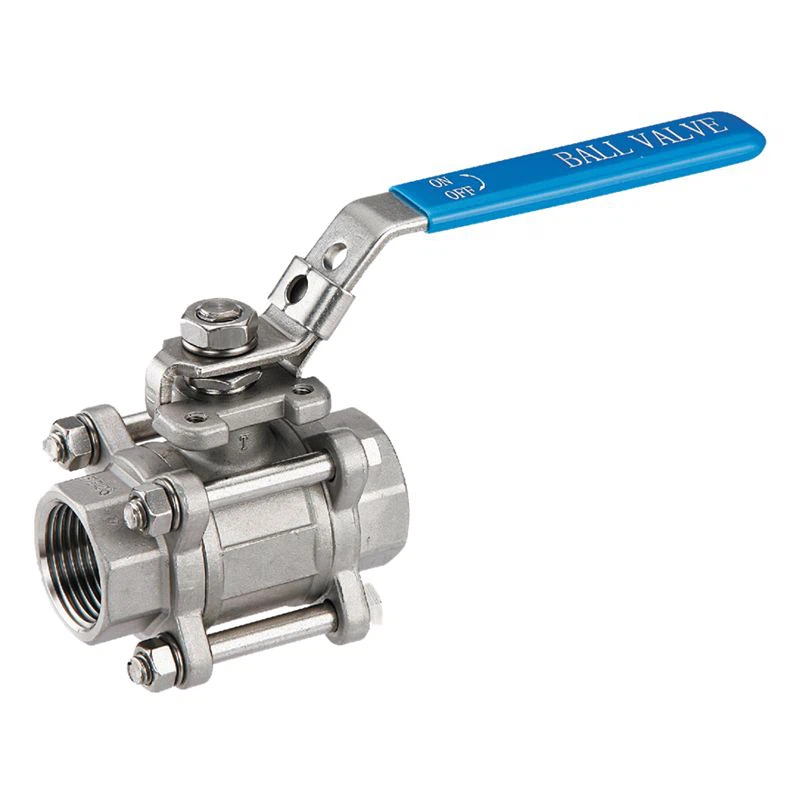

Stainless steel contains chromium, which forms a passive oxide layer on the surface of the stem. This oxide layer protects the stem from corrosion, even when exposed to harsh chemicals or corrosive environments. Different grades of stainless steel can be used depending on the specific application requirements. For example, in applications where the fluid is highly acidic or contains chloride ions, a higher - grade stainless steel such as 316L may be used for the stem.
The corrosion resistance of the stem is crucial for the long - term reliability of the valve. A corroded stem can lose its strength, leading to premature failure of the valve. It can also cause problems with the sealing mechanism, resulting in leakage. By using a corrosion - resistant stem material, the valve can operate effectively for an extended period without the need for frequent maintenance or replacement.
5. Alignment and Stability
The stem also plays a role in maintaining the alignment of the ball within the valve. It ensures that the ball rotates smoothly and accurately within the valve body. A misaligned stem can cause the ball to bind or not rotate properly, leading to poor valve performance.
The stem is designed to fit precisely into the valve body and the ball. It has a specific diameter and length that are carefully engineered to ensure proper alignment. In addition, the stem is supported by bearings or guides within the valve body, which help to maintain its stability during operation.
In some valve designs, the stem may also have a locking mechanism to prevent accidental rotation. This is particularly important in applications where the valve needs to remain in a specific position for safety reasons. For example, in a gas pipeline, a valve that is accidentally opened or closed can pose a significant safety hazard.
6. Impact on Valve Performance and Lifespan
The overall performance and lifespan of a stainless steel threaded ball valve are greatly influenced by the quality and design of the stem. A well - designed stem can improve the valve's efficiency, reduce leakage, and increase its durability.
A stem with a smooth surface finish and proper lubrication will experience less friction during operation. This not only reduces the torque required to open and close the valve but also minimizes wear on the stem and other valve components. As a result, the valve can operate more smoothly and reliably over a longer period.
On the other hand, a poorly designed or low - quality stem can lead to a variety of problems. It may cause excessive leakage, require high operating torques, and be prone to corrosion and wear. These issues can result in frequent maintenance, downtime, and ultimately, a shorter lifespan for the valve.
Conclusion
In conclusion, the stem in a stainless steel threaded ball valve is a critical component that performs multiple important functions. It serves as the mechanical link for actuation, maintains sealing to prevent leakage, transmits torque for proper valve operation, offers corrosion resistance, ensures alignment and stability, and has a significant impact on the valve's performance and lifespan.
As a supplier of stainless steel threaded ball valves, we understand the importance of using high - quality stems in our products. We carefully select the stem materials, design the stem geometry, and implement strict quality control measures to ensure that our valves meet the highest standards of performance and reliability.
If you are in need of stainless steel threaded ball valves for your industrial applications, we invite you to contact us for a detailed discussion. Our team of experts can provide you with the right valve solutions tailored to your specific requirements.
References
- Valve Handbook, Crane Co.
- ASME B16.34 - Valves - Flanged, Threaded, and Welding End.
- API 6D - Pipeline Valves - Specification for Pipeline Valves.